Germany Is a Home-Office Leader in 2025: Numbers, City Ranking & HR Playbook
Germany ranks among the world's top countries for remote job postings in 2025. What the latest figures mean for recruiting, retention, compliance and health – plus a 7-step playbook for HR.
According to the latest data, Germany remains a home-office stronghold in 2025. A Q2/2025 analysis shows: the share of job ads offering a remote option in Germany is high – and globally near the top. What does this mean for recruiting, retention, health and compliance? Here is the compact overview – with practical steps for HR teams.
Source: "Germany leads internationally: home office remains a trend" (OnlineMarketing.de, 25 August 2025).
Key numbers in 60 seconds
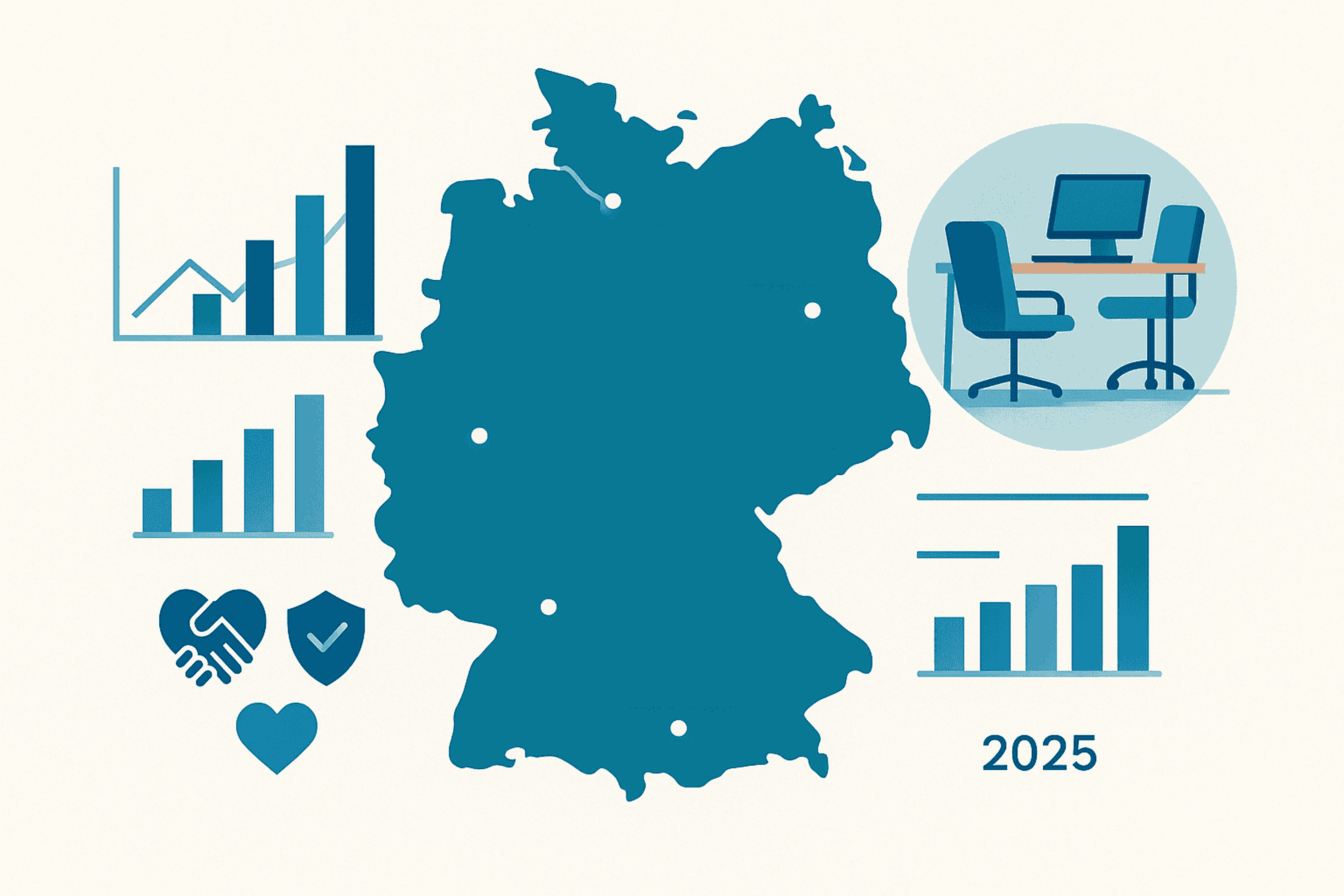
- 14.8 % of all German job ads in Q2/2025 offered a home-office or remote option (stable vs. early 2025).
- By country, only the UK is slightly ahead (≈ 15.1 %), Canada ≈ 13.8 %, France ≈ 11 %, USA ≈ 7.8 %.
- Demand remains strong: 3.3 % of searches on major job platforms explicitly target remote jobs (pre-pandemic: 0.7 %).
- City ranking: in major cities the remote share averages ≈ 23.6 %. Düsseldorf leads with over 35 %, closely followed by Munich, Stuttgart, Berlin, Frankfurt (each > 30 %). Koblenz surprises with ≈ 28.6 %; at the bottom: Heilbronn, Mönchengladbach, Krefeld (< 17 %).
Takeaway: flexible work is firmly established in Germany – candidates expect clear remote options, especially in metro areas. Companies without an offering lose visibility and reach.
What this means for HR leaders
1) Recruiting reach and time-to-hire
Because remote-friendly job ads decouple commuting distance, the talent pool grows substantially. In bottleneck profiles, time-to-hire and cost-per-hire often drop – provided the ad clearly states how remote works (e.g. "remote-first" or "hybrid 3/2").
2) Retention & employer brand
Today, retention isn't driven only by salary, but also by flexibility. Mandating office presence without solid reasoning risks attrition, especially in knowledge-intensive roles. An honest remote policy strengthens both retention and employer branding.
3) Cost & productivity
Hybrid models often save office and travel costs, but productivity gains only materialize when home workplaces are ergonomic and context switches are limited through meeting hygiene. Targeted investment in equipment and work organization pays off.
4) Compliance & health (mandatory!)
The risk assessment applies also to the home office. Employers should systematically check, document and define minimum standards – or face health risks and legal gaps.
Playbook: 7 steps from intent to impact
- Cluster job profiles to identify which roles can deliver 60–100 % remote.
- Define remote levels (e.g. remote-first / hybrid x:y / office-preferred) and make them transparent in the job spec.
- Align the benefit stack: ergonomics budget, equipment, focus-time rules, meeting hygiene, mental health.
- Boost visibility: add "(Remote)" or "(Hybrid)" to titles and snippets; deliberately use job board filters.
- Open up geography: target metros and B-cities; run campaigns in Düsseldorf, Munich, Berlin, Frankfurt.
- Lock in compliance: digital risk assessment, documentation, clear minimum standards, data protection.
- Measure impact: review a KPI set (time-to-hire, offer acceptance, sick days, attrition, eNPS, productivity) regularly and refine the policy.
Best practice: professionalize home office – with onyo
onyo is Europe's leading provider of Home-Office-as-a-Service. We combine equipment, compliance and wellbeing into one continuous process so companies don't just allow hybrid work – they make it work:
- Equipment: employees choose what they need; we handle delivery, installation and returns.
- Compliance: digital risk assessment with documentation for audit-proof records.
- Wellbeing & coordination: 1:1 sessions, home-office monitor, active breaks, desk booking.
Why onyo? HR Innovation Award 2023 · references from enterprise to SMB (e.g. NTT Data, sevDesk) · ø ~EUR 25 per month/employee.
Checklist: a robust remote policy in 30 days
- Define remote levels and presence rules per role
- Set ergonomic minimum standards for the home office
- Launch & document a digital risk assessment
- Publish an equipment catalogue with budget framework
- Communicate meeting guidelines & focus times
- Establish a KPI baseline (attrition, sick days, eNPS)
- Onboard a pilot team, feedback loop after 30 days
Conclusion
Germany remains a home-office leader in 2025 – a competitive advantage for companies that use remote work strategically. Those who proactively secure health, productivity and compliance win the war for talent.