Savills study 2026: How can we measure the value of the office?
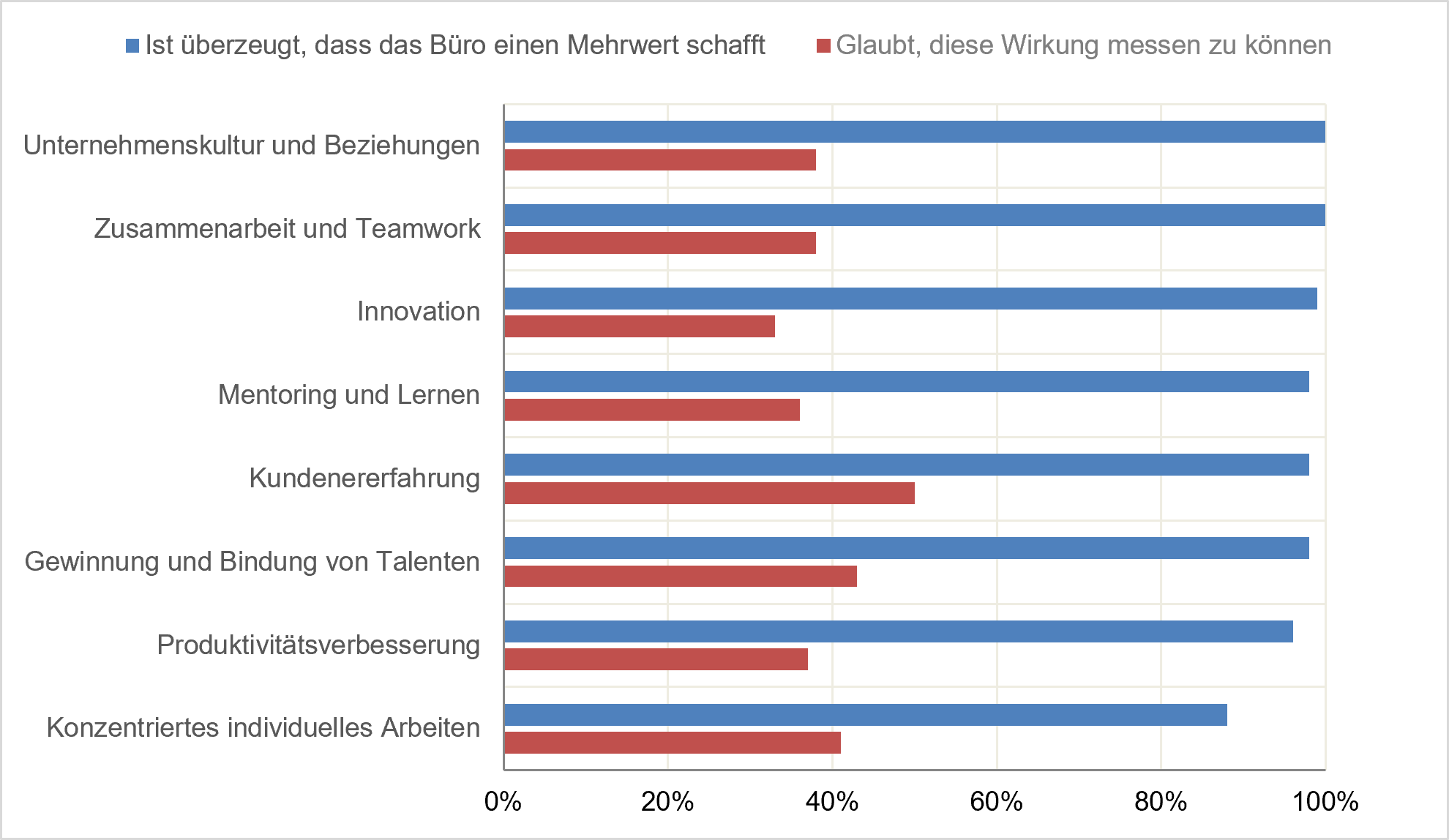
99% see office value for culture and collaboration, but only 38% consider it highly measurable. What the Savills study means for HR, occupancy and hybrid work.
The office is expected to strengthen culture, support collaboration and enable innovation. But how can a company tell whether it delivers? The Savills and CoreNet Global Measuring the Value of the Evolving Workplace Survey 2026 reveals a substantial gap between perceived office value and confidence in measuring it.
For HR and business leaders, the implication is practical: a hybrid workplace strategy needs more than an attendance target. It needs clear objectives, appropriate workplaces and observable outcomes.
Key findings from the Savills study
The global survey received responses from more than 240 corporate real estate and workplace professionals. Respondents described, among other things, their executive leadership’s attitudes towards workplace investment.
- 41% said leadership sees the workplace as a driver of culture and collaboration.
- 23% said leadership sees it as a strategic advantage. Together, these groups represent 64%.
- 13% said it is primarily viewed as an operational cost to manage.
- 16% said leadership supports investment but wants stronger evidence of value.
99% saw office value for culture and collaboration, yet only 38% on average considered that contribution highly measurable. Likewise, 99% saw value for innovation and idea generation, but only about one-third regarded that impact as clearly quantifiable.
What the survey does and does not establish
This is a survey of professional perceptions. It is not an experimental demonstration that office work is more productive than working from home. Low measurement confidence does not prove that the office has no value either. It indicates that many organisations struggle to connect expectations with suitable evidence.
Respondents came from a global professional network. The findings should not be treated as representative of every German employer or the workforce as a whole.
Occupancy is not the same as a business outcome
73% of respondents use employee engagement surveys and 65% use workplace utilisation or occupancy data. Half use financial or business performance measures, 33% track retention, 22% examine productivity or performance, and only 13% assess collaboration or innovation.
Occupancy tells you how often space is used. It does not automatically tell you whether projects progress faster, onboarding improves or collaboration becomes more effective. Bookings and actual attendance also need to be distinguished.
Workplace Analytics can help structure space and attendance planning. This is one input into an evaluation, not a complete measure of culture or productivity.
Five steps towards a measurable hybrid strategy
- Define the objective: Decide whether office time should improve onboarding, knowledge exchange, client contact or joint problem-solving. Choose a suitable measure for each goal.
- Establish a baseline: Record occupancy, team feedback and relevant business outcomes before making a change.
- Give office days a purpose: Coordinate attendance around activities that benefit from meeting in person. The free Hybrid Work Policy Generator supports clear rules.
- Combine perspectives: Consider occupancy and sentiment alongside suitable outcomes such as project delivery times, error rates or onboarding feedback.
- Review a pilot: Compare similar teams or periods and account for workload, staffing changes and seasonality.
These steps are onyo’s practical interpretation, not a Savills-tested guarantee of improvement. An association between attendance and outcomes does not on its own demonstrate causation.
Put workplace costs in context
In a separate analysis of 50 publicly listed multinational companies, Savills estimates that workplace costs average 8.4% of revenue and 12.5% of operating costs. These figures do not come from the survey of more than 240 professionals and are not a universal benchmark for German SMEs.
Use your own rent, operating and equipment costs when planning. Desk sharing can reduce the number of assigned desks. Whether this translates into lower rent depends on the space design, peak demand and lease arrangements.
Design the office and home workplace together
The report gives global average actual office attendance as 3.6 days per week. This is a descriptive figure, not a recommendation for an optimal attendance policy. The EMEA average is 3.4 days; it is not a Germany-specific statistic.
Rather than declaring one work location the winner, improve conditions in both: meaningful interaction in the office and focused, ergonomic work at home. Home office equipment for employers helps companies equip the second workplace. It complements the office strategy but does not replace outcome measurement.
Frequently asked questions
Does the Savills survey justify a return-to-office mandate?
No. It examines perceptions of workplace value and measurement confidence, not the causal effect of attendance mandates on performance.
Which measures should HR and workplace teams use together?
Combine actual utilisation, employee experience and relevant business outcomes. The choice depends on the objective; attendance alone is not adequate evidence of success.
Where can I download the report?
The three-page English-language report is available in our whitepaper library and as a direct PDF download.
Conclusion: Measure value, not just attendance
The findings support a more precise hybrid-work debate: what should the office deliver, and how will we know it succeeds? Combining utilisation, employee feedback and outcomes provides a stronger basis for investment and attendance decisions.
Want to connect your office strategy with home workplace equipment? Talk to onyo about your hybrid workplace.
Sources and interpretation
- Savills Research: Global Occupier Strategy, September 2026, pages 1–3.
- CoreNet Global and Savills: Measuring the Value of the Evolving Workplace Survey 2026; combined results across CoreNet membership and the Savills global network.
- Supplied German Savills summary dated 28 September 2026. Figures in this article follow the original report’s prose; no additional percentages have been inferred from chart bar lengths.