Home Office Improves Workplace Culture: Capterra Study & HR Insights
Capterra survey 2022: up to 31% less arguing, gossip and bullying since teams went hybrid or remote. What the numbers mean for HR and how to foster a healthy remote work culture.
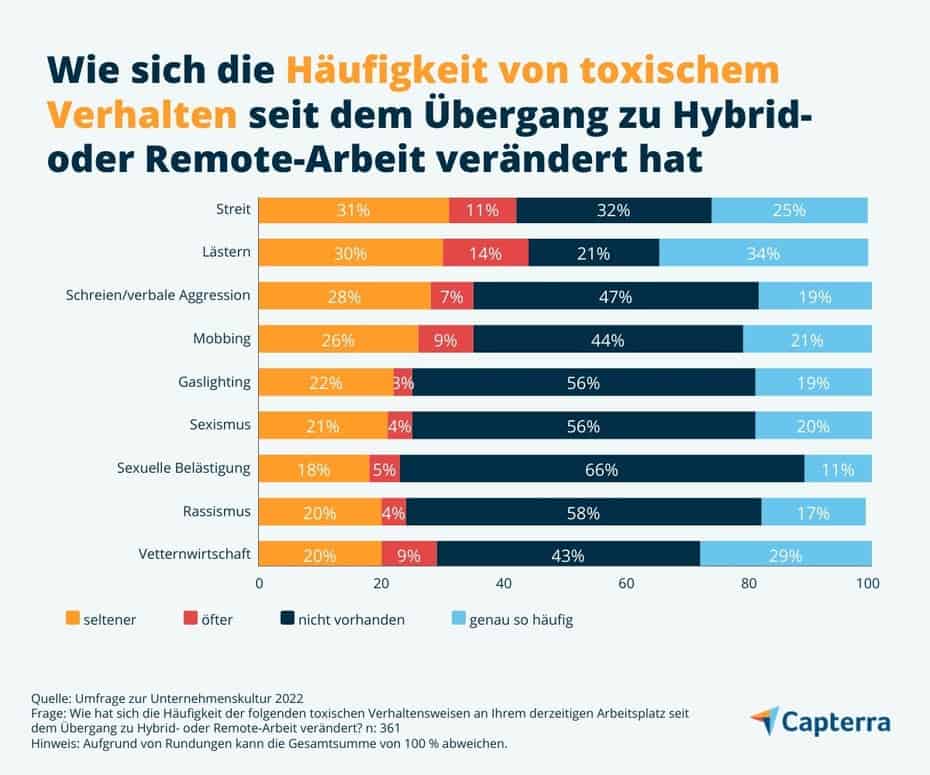
Home office improves workplace culture – and a toxic culture costs productivity, health and ultimately talent. A 2022 Capterra survey of 993 employees in Germany delivers surprisingly clear numbers: since companies switched to hybrid and fully remote work models, 31% of employees report less arguing, gossip or shouting. At the same time, 22% feel more comfortable reporting toxic behavior.
The findings show that home office is more than a temporary stopgap – it has the potential to create a healthier, more inclusive corporate culture. In this article, HR leaders will learn why remote work improves the workplace climate and how to promote it strategically.
1. Key findings of the Capterra survey
Capterra study 2022 (n = 361): up to 31% less arguing and other toxic behaviors since teams started working hybrid or remote.
Takeaway: Distance reduces the frequency of direct conflicts, while digital channels make it easier to report issues.
1.1 Why home office reduces toxic behavior
- Physical distance prevents spontaneous escalations.
- Asynchronous communication forces teams to write more clearly instead of reacting impulsively.
- More privacy when filing complaints: HR channels can be anonymized digitally.
2. What does this mean for HR decision-makers?
2.1 Designing home office proactively, not reactively
- Flexible remote policy: clear support for working from home – not just tolerance.
- Ergonomic equipment: with onyo Home-Office-as-a-Service, employees order monitors, office chairs and lighting in a legally compliant way.
- Regular pulse checks: short, anonymous surveys uncover conflicts early.
2.2 Don't forget compliance & occupational safety
Under German law (§ 618 BGB), employers are obliged to provide ergonomic workstations – including in the home office.
- Run a digital risk assessment with onyo and store the documentation in an audit-proof way.
- Ensure the equipment of employees in the home office with healthy work tools.
3. Practical tips: how to foster a healthy remote work climate
- Establish psychological safety – train managers in empathic communication.
- Stand-ups & retros – fixed meeting rhythms provide structure and prevent silos.
- Digital whiteboards (e.g. Miro) – increase participation and transparency.
- Virtual movement breaks – five minutes of stretching boost well-being.
- Desk booking for office days – avoids overcrowding and improves planning.
4. Conclusion
The data speaks for itself: home office not only reduces costs and commuting times, it measurably contributes to a better workplace culture. HR teams should recognize this potential and actively promote remote work – with clear policies, good equipment and a remote-first culture.
Sources
- Capterra survey: Toxic workplace culture? Working from home makes corporate culture less toxic, published 22 September 2022.
(All percentages rounded)