Passport Home Office: Wrong Incentives, Important Insight – Why Remote Work Is Gold for Employees
Berlin's immigration office ties home office to naturalization quotas. What the "passport home office" affair reveals about the true value of remote work – and how HR should do it right.
Introduction
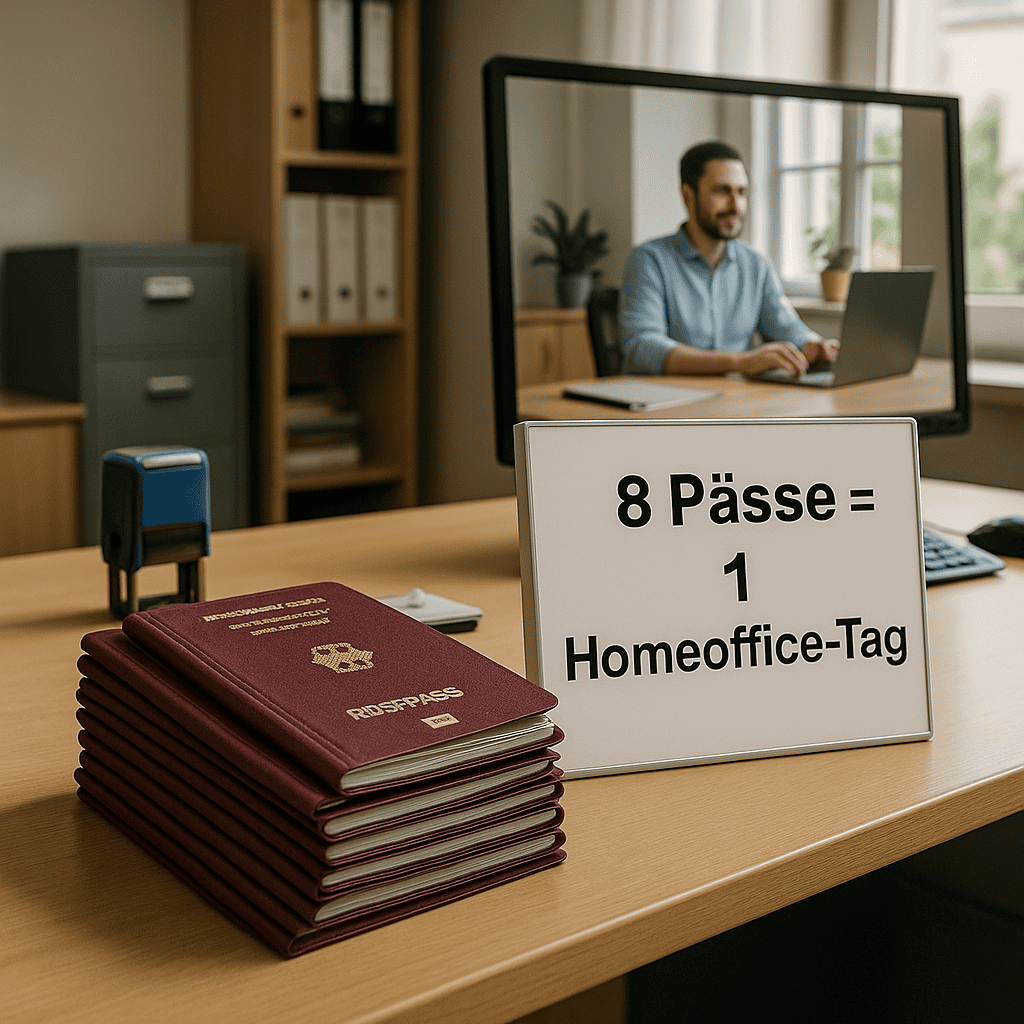
A recent Focus article made headlines: "Naturalize enough people, and you can work from home" – a Berlin insider even calls it "passport coercion" (focus.de).
What initially sounds like a bureaucratic farce reveals two key points:
- Wrong incentives – home office is misused as a reward for high naturalization numbers.
- High employee demand – the rule clearly works because remote work is a highly desired condition.
This article puts the news in context, shows the dangers of such mechanisms – and gives HR teams concrete recommendations to do remote work right.
1. What Focus reports
"Each employee […] must process eight naturalizations per week. In return, home office becomes possible."
- 40,000 new passports: The Berlin State Office for Immigration (LEA) plans to nearly double its naturalizations in 2025.
- Pressure on employees: An insider talks about "producing high numbers" under time pressure.
- Home office as reward: Only after meeting the weekly quota are employees allowed to work remotely.
1.1 Why this is problematic
| Aspect | Risk |
|---|---|
| Ethics | Links a freedom right (place of work) with politically sensitive KPIs. |
| Compliance | Risk of perverse incentives → rushed or flawed naturalizations. |
| Culture | Home office is communicated as a favor, not as a modern work model. |
2. What the story still proves: home office is gold
The criticized practice would have no effect if employees didn't care about home office. The opposite is true:
- Flexible work has the same effect as an 8 % salary increase and reduces resignations by 35 %.
- 40 % of employees would accept a pay cut of ≥ 5 % to stay remote permanently.
- 62 % would even accept 10 % less salary if they could work from home.
Takeaway: whoever controls access to home office controls motivation – for better or worse.
3. Right instead of wrong incentives: recommendations for HR
| Step | What to do | Benefit |
|---|---|---|
| Remote-first policy | Make place of work free by default; require presence only with clear justification. | Fairness, trust, productivity. |
| Output-based performance system | Measure goals via OKRs, not office presence. | Reduces micro-management. |
| Ergonomic equipment | Provide chairs, monitors & lighting compliantly via onyo Home-Office-as-a-Service. | Health, workplace safety. |
| Transparent KPIs | Tie bonuses to outcome KPIs, not politically sensitive quotas. | Ethics & compliance. |
| Culture & trust | Regular retros, foster psychological safety. | Engagement, innovation. |
4. Conclusion
The Berlin "passport home office" deal is a textbook case of bad incentivization – yet it inadvertently shows how valuable remote work is for employees. Instead of using home office as a reward for questionable targets, companies should design it strategically, fairly and healthily. Those who act now win loyalty, productivity and cost savings.