Workplace Accident in Home Office: When Lunch Breaks Are Insured – Two Rulings from Hesse
Two recent rulings by the Hessian Higher Social Court show: A lunchtime walk to a kebab shop can be a workplace accident – but not always. What HR and employees need to know.
A fall on the sidewalk – and suddenly the question arises: Is this a workplace accident? Two recent rulings by the Hessian Higher Social Court (June 2026) show how thin the line between insured business route and private activity is in home office settings. For HR leaders and employees, this case law is important guidance – especially because the front door of the apartment becomes the legal boundary.
The Kebab Case: Why a Broken Arm Counts as a Workplace Accident
In case L 3 U 189/24, a full-time employee worked from home during the COVID pandemic. During her lunch break, she walked to a kebab shop, fell on the sidewalk, and broke her upper arm.
The Hessian Higher Social Court recognised the incident as a workplace accident. The decisive factor was the so-called intention of action (Handlungstendenz): the woman did not simply want to satisfy hunger – she wanted to preserve her ability to work through the afternoon. Combined with her organisational integration (morning and afternoon meetings, formally signing off for lunch with colleagues), this was enough to trigger statutory accident insurance coverage.
The Terrace Case: Why a Torn Ligament Was Not Insured
The parallel case L 3 U 176/25 went the opposite way. An employee worked remotely on a colleague's terrace. After 4.5 of a contracted 6 working hours, he went to fetch two kebabs to eat together on the terrace. On the stairs he twisted his knee and tore a cruciate ligament.
No workplace accident, the court ruled. The reasoning reveals the fine boundaries of German case law:
- No qualifying intention of action: He descended the stairs to eat on the terrace – not to preserve his ability to work.
- Insufficient remaining working time: With only 1.5 hours left in a 6-hour day, lunch no longer served to preserve his working capacity.
- Lack of organisational integration: Without fixed meetings or break requirements, he was not sufficiently embedded in operational workflows.
The Front Door as a Legal Boundary
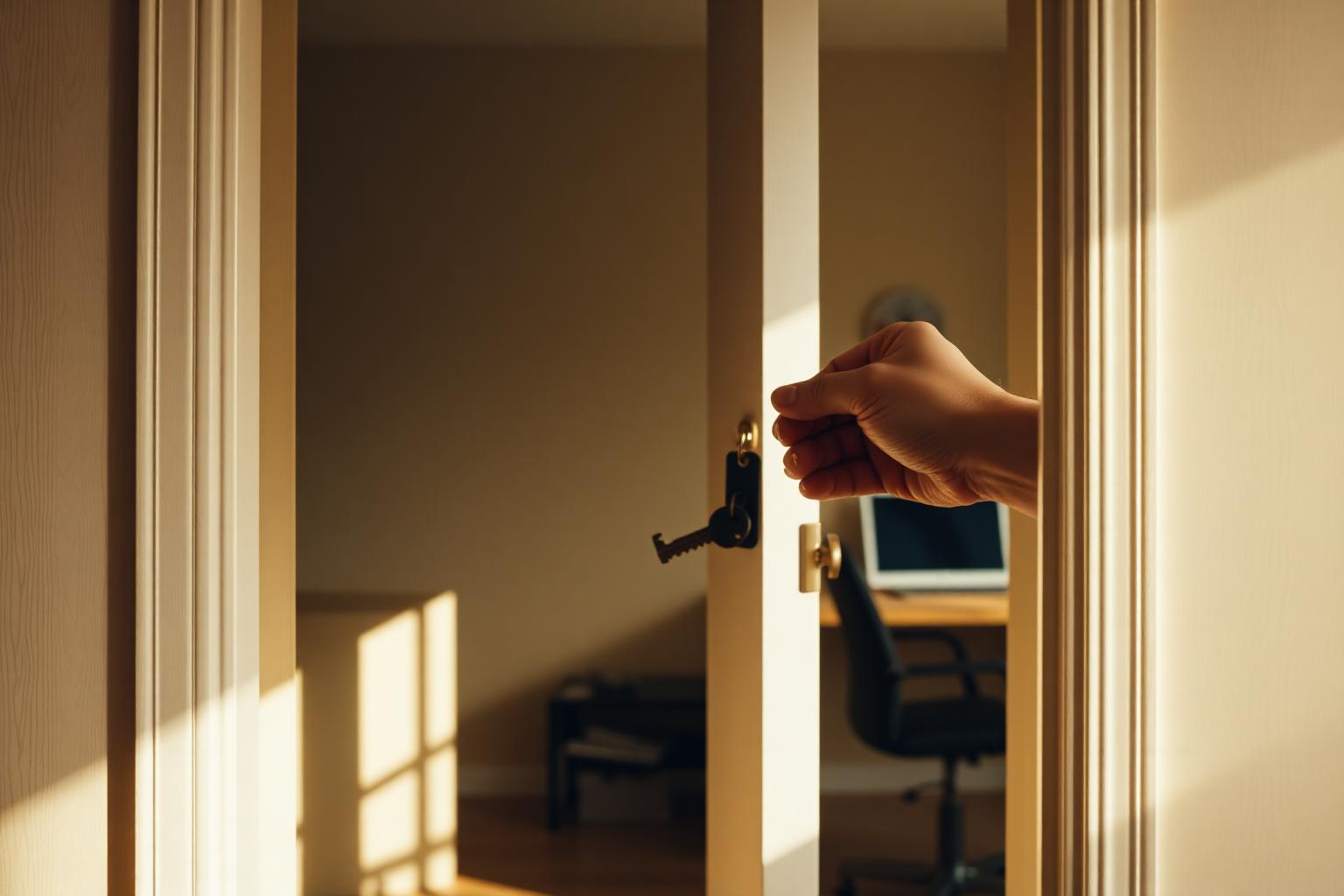
The most important principle from both rulings: In mobile work and home office arrangements, the front door of the residence marks the boundary between business route and commuting route. Inside the home, stricter standards apply. Going down the stairs to a private terrace to eat is private motivation – even if you plan to keep working on the side.
For HR and compliance, this means: clear home office agreements, documented working hours, and defined breaks not only create structure but are also insurance-relevant. Being able to prove that employees were embedded in fixed operational processes significantly strengthens their legal position in disputes.
What Employers Should Do Now
- Put home office rules in writing: The workplace (home, co-working space, colleague's terrace) should be explicitly agreed as the operational site. Our Hybrid Work Policy Generator helps with this.
- Track working hours and breaks: Time tracking creates clarity about work versus lunch – decisive for the intention-of-action test.
- Conduct a risk assessment: Employers are also legally required to perform a risk assessment for home offices. It is the basis for prevention and evidence.
- Educate employees: Clarity about the scope of statutory accident insurance reduces conflict and anxiety.
Conclusion: Home Office Requires Clear Structures
The Hessian rulings show that the home office is neither a legal grey zone nor a zone of automatic full coverage. Statutory accident insurance applies when routes and activities are demonstrably work-related. For companies this means: anyone who wants to make home office attractive, safe, and legally clean needs clear agreements, transparent working hours, and a structured equipment and health strategy.
Related reading: How home office boosts birth rates and why return-to-office fails despite 20% higher productivity.
Sources
- Hessian Higher Social Court, judgement of 25 June 2026, L 3 U 189/24 (appeal pending at Federal Social Court under B 2 U 8/26 R)
- Hessian Higher Social Court, judgement of 19 May 2026, L 3 U 176/25 (appeal pending at Federal Social Court under B 2 U 9/26 R)
- t-online: "Kebab run, fall, still insured" (30 June 2026)
- Haufe: "Accident insurance during lunch break in home office" (30 June 2026)