Office Utilization Jumps to 53%: What the CBRE 2026 Study Means for Hybrid Work
Global office utilization rose from 38% to 53% in 2025 – the largest annual gain since 2021. The CBRE Global Workplace & Occupancy Insights 2026 report shows people come to the office for collaboration, not for attendance mandates. The key figures and what HR and workplace leaders should take from them.
CBRE tracks occupancy data across roughly 1.2 billion sq. ft. (111.5 million m²) of office space worldwide. Part four of its Global Workplace & Occupancy Insights 2026 series is therefore one of the most robust data sets available on how offices are actually used today. The conclusion is clear: the office is coming back – but in a fundamentally different role than before 2020.
The headline numbers
- 53% average utilization globally in 2025, up from 38% in 2024 – the largest annual gain since 2021.
- 80% peak utilization on global average, above the pre-pandemic 65–70% range.
- 111% occupancy: there are more employees than desks – desk sharing has become the norm.
- 37% of organizations actively enforce attendance policies (2024: 17%), and 69% measure compliance (2024: 45%).
Colleagues bring people in – not mandates
The most important finding: employees are significantly more likely to come in when the majority of their team is present. CBRE calls this the affiliation imperative – belonging as the real driver of office attendance.
93 percent of respondents cite collaboration with colleagues as a very or somewhat important reason to be in the office. In-person meetings follow at 90 percent, team building and social interaction at 89 percent. Management expectation ranks noticeably lower.
Revealing detail: only 35 percent name better focus and concentration as an important reason. For most people, deep work still happens at home – which is exactly why a properly equipped home workplace remains the precondition for hybrid working to function at all.
Space is being reallocated: fewer desks, more connection
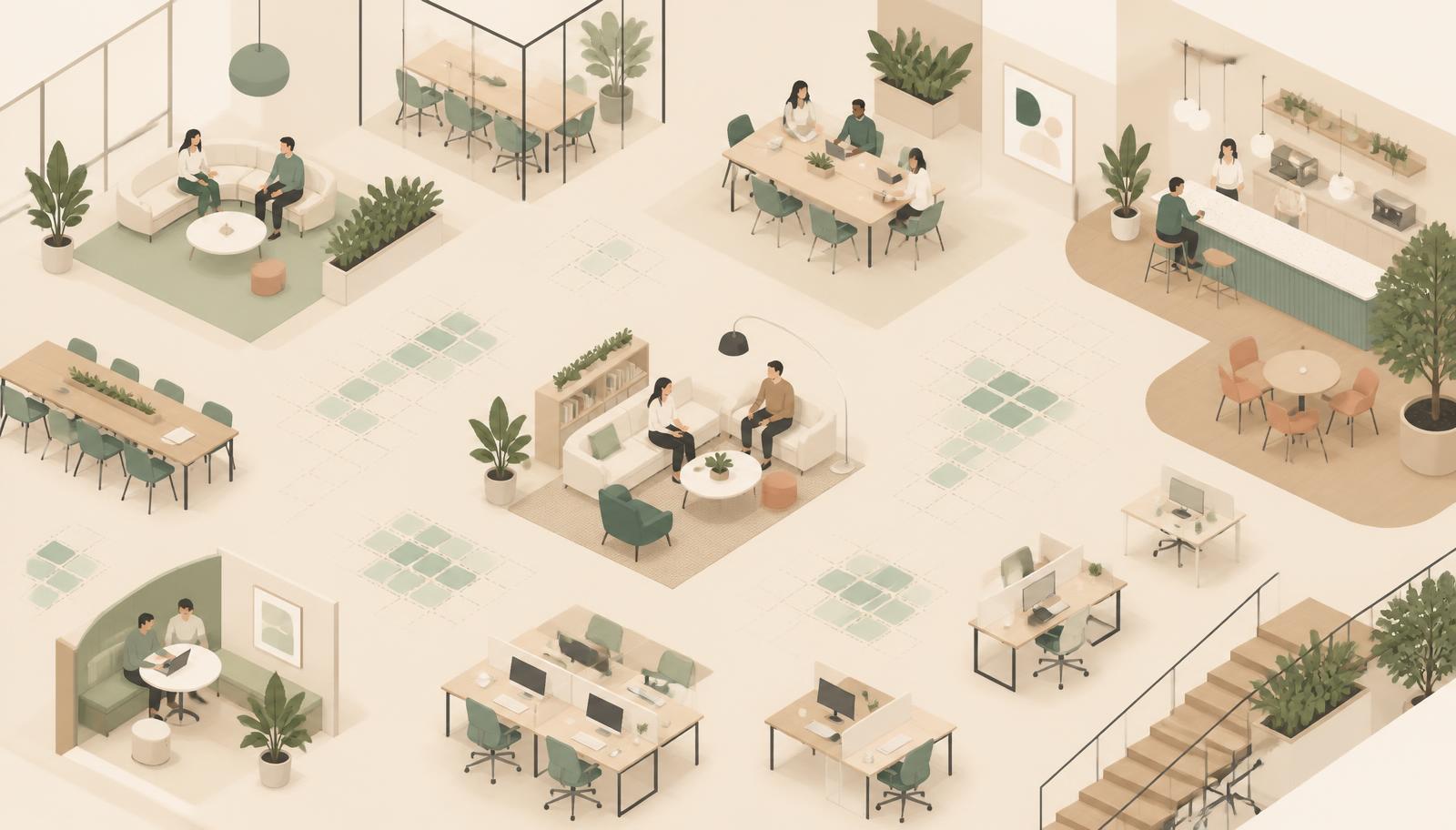
Utilization patterns show up directly in space planning. CBRE’s Americas benchmarking data reveals a clear trend since 2021:
- Individual “Me” space fell from 56% to 35% of total space composition.
- Shared support space – meeting and project rooms – grew by 35%.
- Amenity space for social connection is the fastest-growing category, up 120% since 2021.
In EMEA, space per seat has increased by 14% since 2021, reversing a long-term densification trend. In Asia-Pacific, 57% of CBRE clients expect to expand their portfolios further.
Desk sharing is the new default
The classic 1:1 employee-to-desk ratio is now the exception. Assigned seating declined from 83% to 55% of organizations, while hybrid and desk-sharing models rose from 12% to 36%. Most organizations target ratios between 1.01 and 1.49 employees per seat; one third pushes beyond 1.5.
What matters is the evidence base: 83% factor job function into sharing ratios and 78% calibrate them with real utilization data. You can model the right ratio for your own site with our workplace analytics tool.
Why engagement is more than a real estate question
CBRE links its space data to decades of Gallup research:
- Employees with a best friend at work are seven times more likely to be fully engaged.
- Engaged teams are 23% more profitable than disengaged ones.
- Global disengagement cost the world economy roughly $10 trillion in 2025 – about 9% of global GDP.
Organizations that proactively invested in collaboration and amenity space hit their attendance goals more often and reported higher satisfaction with the workplace experience.
AI is reshaping the workday – but not the way many expect
Adoption of AI agents is expected to grow 327% over the next year, and 79% of organizations already reported some implementation in 2025. The effect on daily work is counterintuitive: employees in roles with high AI exposure currently work 2.75 more hours per week, not fewer. Productivity gains are flowing into output, not into reclaimed time.
At the same time, meeting time has more than tripled since February 2020. 57% of the average office worker’s time goes to meetings, email and chat, leaving only 43% for focused creative work. And the share of employees who clearly know what is expected of them fell from 55% (2019) to 44% (2024). CBRE describes a workforce that is “over-coordinated and under-connected”.
Five strategic priorities for employers
- Redefine the success metric. Utilization alone is insufficient. Employee sentiment, collaboration quality, goal clarity and engagement are the metrics that matter.
- Design for affiliation. Social and amenity space was historically underfunded – it now grows fastest among top-performing occupiers.
- Develop a data-led attendance strategy. Role-based approaches beat uniform mandates. Our hybrid work policy generator creates a clear policy in minutes.
- Build the technology backbone. Reservation systems, presence sensing and occupancy analytics make it visible who will be in – and that visibility drives attendance. Desk booking is the entry point.
- Treat the office as a strategic asset, not a fixed cost to be minimized.
What this means for hybrid organizations
The CBRE data refutes both popular extremes. The office is neither dead nor returning to its old role. It becomes the place for collaboration, culture and relationship building – while focused work stays distributed.
For employers this implies a dual investment logic: high-quality collaboration space in the office and a professionally equipped workplace at home. Serving only one side costs you either culture or productivity. That is exactly where onyo comes in – with standardized budgets, reliable compliance and a platform where employees configure their own equipment.
Conclusion
53% utilization, 111% occupancy, +120% amenity space: the CBRE 2026 report documents a redefinition, not a return. Organizations that align their space and equipment strategy with affiliation rather than attendance quotas will have the advantage in 2027.
Source: CBRE, “The Affiliation Imperative: The Office’s New Purpose – What the Data Shows”, Part 4 of the 2026 Global Workplace & Occupancy Insights series, 2026. The full report is available in our whitepaper library.